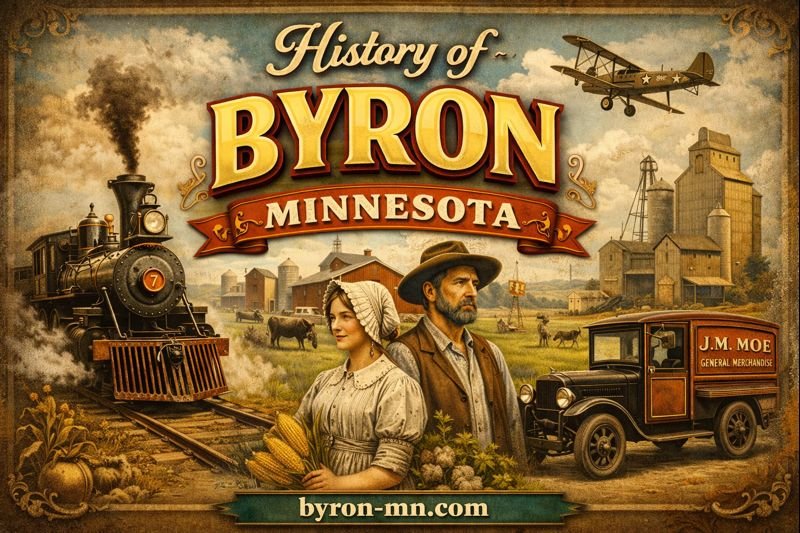
History of Byron, Minnesota
A Small Town with Deep Roots in Southeastern Minnesota
Byron, Minnesota – Olmsted County
Byron is a city in Olmsted County, Minnesota, located approximately five miles west of Rochester and six miles east of Kasson on U.S. Route 14. With a population of 6,312 according to the 2020 census, Byron has grown from a small railroad settlement into a thriving bedroom community for nearby Rochester, home of the world-renowned Mayo Clinic.
Early Settlement and Founding
Before Byron existed, a small community known as Bear Grove occupied the area west of present-day Byron. The town’s origins trace back to the construction of the Winona and St. Peter Railroad, which reached westward through the region to neighboring Kasson in 1865.
Byron was platted in 1864 by George Washington Van Dusen (1826-1915), a grain dealer from New York who became one of the wealthiest businessmen during Minnesota’s milling boom in the second half of the 19th century. Van Dusen had followed the grain trade westward from Wisconsin to Rochester, Minnesota, where in 1865 he began building grain elevators and warehouses along the railroad lines under his company, G.W. Van Dusen & Co.
Van Dusen built a warehouse at the Bear Grove settlement and is credited with renaming the village to its present name of Byron, after the town of Port Byron, New York, where he once lived. His father, Laurence Van Dusen, had been born in Byron Center, Genesee County, New York, which may have also influenced the naming.
Incorporation and Early Growth
Byron was officially incorporated in 1873. A post office called Byron has been in continuous operation since 1868, serving as a vital link for the growing community.
The railroad quickly became Byron’s lifeline. The original train station was located west of what is now Byron Avenue and was rebuilt in 1883. The Chicago and North Western Railway gained control of the Winona and St. Peter Railroad a few years after the line reached Byron. The C&NW operated the line until the 1980s, when it was spun off to create the Dakota, Minnesota and Eastern Railroad (DM&E).
Though much of the original downtown was lost to fires over the years, the legacy of Byron’s beginnings continues to shape its identity today. The city is surrounded by Kalmar Township, which was organized in May 1858 and named after a seaport in southern Sweden.
The Van Dusen Legacy
George W. Van Dusen’s business empire grew substantially. By 1888, he was president and general manager of his company, which controlled more than 90 grain elevators stretching from Winona to Pierre, South Dakota. That same year, the company was sold to English investors in London and merged by 1889 with Charles M. Harrington’s Minneapolis company to become Van Dusen-Harrington. This company eventually became part of the Peavey Company, which was acquired by ConAgra in 1982.
Van Dusen died in Minneapolis on February 24, 1915. His remains lie in a mausoleum at Oakwood Cemetery in Rochester, Minnesota. The George W. and Nancy B. Van Dusen House, a mansion he built in Minneapolis in 1891, was listed on the National Register of Historic Places in 1995.
Need a Website for Your Byron Business?
The Inventor’s Velocity provides professional web development and digital marketing services for businesses throughout Minnesota.
Contact Us TodayTIV360.com – WordPress Development • Local SEO • Digital Marketing
Byron Today
The 20th century brought significant changes to Byron. While it remained a farming community for decades, the post-World War II suburban boom and Rochester’s growth as a medical and economic hub transformed Byron into a residential haven.
Local industries today include farm services and printing. A grain elevator remains situated next to the rail line that runs through town, now owned by the Dakota, Minnesota and Eastern Railroad. Schmidt Printing, a subsidiary of Taylor Corporation, is another major employer in the community.
Byron has experienced steady population growth over the decades. From 1,419 residents in 1970, the population grew to 1,715 in 1980, 2,441 in 1990, 3,500 in 2000, and 4,914 in 2010, before reaching 6,312 in the 2020 census.
Education Excellence
Byron Public Schools serves over 2,200 students across four schools: two elementary schools (grades K-2 and 3-5), one middle school (grades 6-8), and one high school (grades 9-12). The current high school building was completed in 2006.
In 2011, Byron High School received the National Blue Ribbon Award from the U.S. Department of Education, recognizing it as one of the top-performing schools in the nation. That same year, the school also received the Minnesota Association of Secondary School Principals’ Star of Innovation award and an Intel Schools of Distinction award.
The district maintains a graduation rate of approximately 95% and consistently ranks among the top school districts in Minnesota.
Parks and Recreation
One of the major parks in Olmsted County, Oxbow Park and Zollman Zoo, is located just 3.5 miles north of Byron on the meandering Middle Branch of the South Fork Zumbro River. The park was established in 1967 and transformed from farm fields into a beautifully preserved natural area.
The zoo was established in 1969 with the donation of native Minnesota animals from John Gilbertson, the regional game warden at that time. Named in honor of Dr. Paul E. Zollman, DVM, in recognition of his dedication to Olmsted County parks and compassionate animal care, the zoo houses over 30 species of native Minnesota wildlife, including wolves, bison, black bears, otters, and birds of prey. The park encompasses over 624 acres with eight miles of hiking trails, camping facilities, and a nature center that was renovated and reopened in May 2023.
Byron also maintains several city parks, a public pool open in the summer, and numerous recreational fields for soccer and baseball. The community is home to Somerby Golf Club and Community, a private golf club located on the north side of the city.
Government and Community
Byron has a mayor and a four-member city council, along with four other government boards including an economic development authority and a park board. Byron City Hall is located near the elementary school on 10th Avenue.
The old city hall stands in the center of town at Byron Avenue and 4th Street and was built in 1938. The city’s first water tower was built next to that location in 1935 and was torn down around 2004.
The Byron city flag consists of three stripes of blue, white, and green, with five stars on the top blue stripe and a bear in the center of the white stripe. The flag’s design was chosen in a citywide contest, with the winning design created by Jeff and Allison Ihrke.
Transportation
Byron offers local community transportation provided by Rolling Hills Transit. A commuter bus service to Rochester is operated by Rochester City Lines, with three trips daily through Byron. Two of those trips go directly to a park-and-ride lot on the eastern edge of town, while the third travels through the city to pick up riders.
The DM&E rail line continues to run through Byron, maintaining the town’s historic connection to the railroad that helped establish the community over 150 years ago.
A Community Looking Forward
From its humble beginnings as a railroad stop named Bear Grove to its present status as a thriving suburban community, Byron has maintained its small-town character while embracing growth and progress. With excellent schools, abundant recreational opportunities, and proximity to Rochester’s world-class amenities, Byron continues to attract families seeking the best of both rural tranquility and suburban convenience.
The community’s rich history, shaped by entrepreneurs like George Van Dusen and generations of dedicated residents, provides a strong foundation for Byron’s continued success in the years to come.